Investigative Science Learning Environment
Helping students learn physics by thinking and acting like scientists.
The ISLE Approach
The Investigative Science Learning Environment (ISLE) approach is an intentional, holistic learning environment which addresses two main goals: to help students learn physics by engaging them in processes that mirror scientific practice, and to improve their well-being while they are learning physics. Specifically, ISLE helps students develop perseverance, growth mindset, and physics identity. We believe that everyone can learn physics given tools, time, and support; therefore, students learning physics through the ISLE approach are encouraged to improve their work without being punished for a second or third attempt.
The ISLE process
A recursive approach to learning physics
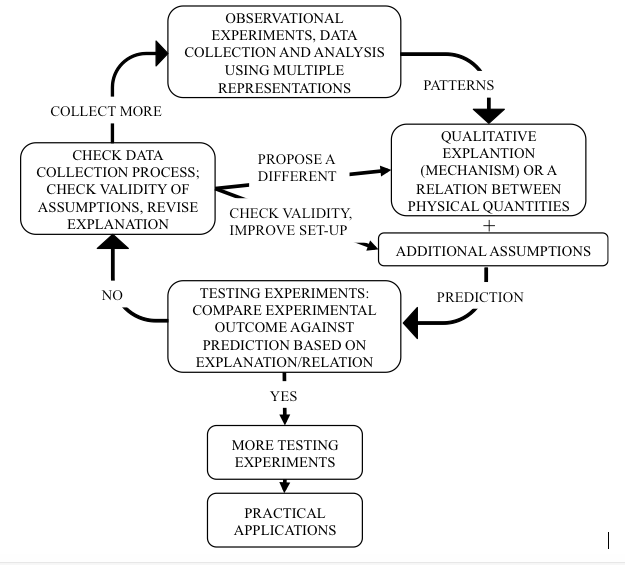
Students move through cycles of observation, explanation, prediction, testing, reflection, revision, and application.
Learning through ISLE
Students develop ideas, test them, and improve their work over time.
This approach involves students working in groups as they develop their own ideas by observing phenomena and looking for patterns, developing explanations for these patterns, using these explanations to make predictions about the outcomes of testing experiments, deciding if the outcomes of the testing experiments are consistent with the predictions, revising the explanations if necessary, and representing physical processes in multiple ways.
The combination of these features is applied to every conceptual unit in the ISLE learning system, helping students develop productive representations for qualitative reasoning and problem solving.
To support students’ confidence, motivation, and well-being while learning physics, one of the important features of the ISLE approach is encouraging students and creating opportunities for them to improve their work multiple times without punishment for multiple trials. While this idea might sound unusual, many ISLE teachers have been using it for years. Eugenia Etkina started this work in 1982 and continued developing it for almost 40 years. Many others have followed.
To help students feel comfortable with the approach, it is important that the classroom becomes a learning community. Building a learning community is one of the goals of this work.
Getting started
To implement the ISLE approach, visit the Textbook Information, Free ISLE Resources, and Adopting ISLE pages on this website and take advantage of the materials created over the last 20 years.
To become part of the community of teachers implementing the ISLE approach, please join the Facebook group Exploring and Applying Physics. When you apply to join, remember to answer the membership question.
Related curriculum project
Looking for PUM?
PUM is a curriculum project grounded in the ISLE approach. Visit the PUM website for curriculum information, teacher resources, and implementation materials.