Why Do ISLE?
When students learn physics, they learn that they have to play an epistemic game. Physics students are acutely aware that they have to “play a game” when they are learning physics. The question is: what sort of game do we want them to play? The most essential thing about the ISLE approach is that it presents students with a set of rules for a non-threatening game that helps students build their identities and abilities as practicing scientists.
Why is it so important to create a non-threatening environment to learn physics?
One of the most common instructional approaches to conceptual change in physics is to ask students to predict what they think will happen in a given physical scenario. For example, students may be asked what will happen when two metal balls of different masses are dropped. Many students will say that the heavier ball will fall faster. The instructor then performs the experiment, and students observe an unexpected result.
It is then assumed that students will realize that their physical intuition needs modifying. Students are expected to resolve the contradiction between their expectations and reality, updating their thinking to accommodate the new information. This model of student cognition has significant problems because it neglects the emotional part of learning.
Research shows that students cling tenaciously to their “incorrect” beliefs, even when they are aware of the outcome of an experiment. Recent research has given us some startling insights into why original ideas are hard to change: people ignore or block out data when it threatens their identity or sense of self.
Student quote
“I have the attitude that I should just believe what they [physics teachers] tell me... the things I see in physics are completely different than what I would normally expect them to be... Even though I’ve seen it in lab, I say ‘OK, I’m just going to pretend it’s true,’ and I work the problems like that... I don’t believe what I’m seeing.”
If a physics class is making students question their intuition or their confidence in their perception of reality, it is almost certainly striking at the core of their sense of self.
Knowledge is more than facts
Knowledge is a combination of two components: The facts, and the system of rules by which those facts are established. These two components are inseparable from each other. In traditional instruction, while instructors may pay attention to how the physics knowledge is established, it does not “rub off” on students.
Here are examples of responses from traditionally taught students who “know” Newton’s third law as identified by their ability to answer the four Newton’s third law questions on the force concept inventory correctly. Students were asked how they knew that Newton’s third law was true:
Traditionally taught students
- 001: Because I took physics 140. I don’t know, I just know that…
- 013: I guess it’s just an established law of physics.
- 014: I remember that from high school…
- 017: …that law is probably one of the only things I took out of physics 140…
- 019: I think it’s one of the laws of physics…
- 033: I remember from my physics class…”every action has an equal and opposite reaction.”
- 037: …just from having a physics class before…forces are always equal when they are opposing each other
In contrast, here are the responses of a group of physics students who took their physics in the ISLE format. They were asked “If someone came to you and asked you: ‘How do you know Newton’s third law is true?’ How would you answer them?”
Students who learned physics in the ISLE format
- 001: I would explain with an example of when a person is pushing against a wall.
- 002: Assuming that this person know of Newton’s first and second law. I would use an everyday real life example such as, me pushing a box of books.
- 003: I’d try saying I know it’s true experimentally and show them somehow. I could use two of those spring thingies we had in class that measures force, hook them up, and pull.
- 005: I would ask them to punch a wall…The pain caused by punching a wall is a result of the force the wall exerts on the fist. As you increase the force behind your punch, the force the wall exerts on your fist increases proportionally, and therefore the pain you experience increases as well.
- 007: By giving them an example…
- 009: I know Newton’s third law is true because my classmates and I assembled an experiment in which we allowed wheeled carts to collide.
- 010: I have, along with others, performed many experiments that support the claim and have not found or devised an experiment that disproves it.
ISLE students achieve this level of epistemological sophistication because they are fully engaged in a process of creating their own physics knowledge by implementing the same reasoning processes that practicing physicists use to create their knowledge. In other words, ISLE physics students learn physics by learning and engaging in the actual process of knowledge creation, by thinking like a physicist. But there is more to the ISLE approach than students practicing physics.
By doing it, the students are engaged in the struggle and overcoming difficulties while being in control of their learning. It is this combination of struggle and control that produces people with growth mindset, people who persevere and achieve their goals. Read below more about the ISLE approach to see how it develops growth mindset and provides opportunities to develop grit.
The ISLE Game
The ISLE approach is a game that models the process by which physicists create their knowledge. The key to what makes it non-threatening is that it is like a mystery investigation. That is why we always introduce the ISLE approach with the “ten TVs” activity, or a similar activity such as 10 tennis rackets or 10 cameras.
Students construct physics concepts and develop science process abilities by emulating the processes that physicists use to construct knowledge. The steps of the ISLE process are as follows:
- We provide students with some interesting physical phenomenon that they probably observed before but never questioned.
- Students gather data about the phenomenon, identify interesting patterns, and come up with multiple causal or mechanistic explanations for why or how the phenomenon is happening. We say “come up with any crazy idea that could explain this” because we do not want students to feel deeply emotionally attached to their ideas.
- Students test their explanations by conducting one or more testing experiments. The primary goal is to eliminate explanations rather than “prove” them. In the ISLE approach, “predicting” means saying what would be the outcome of the testing experiment if a particular hypothesis were true. Ideas that are not eliminated are kept and re-tested with further experimentation.
- Finally, students apply the ideas they have established to solve real-world problems.
The cycle repeats twice, first qualitatively, then quantitatively.
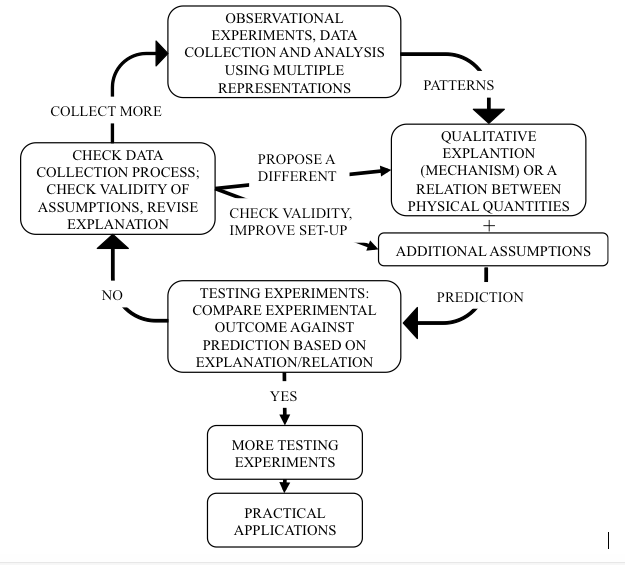
The Four Components of the ISLE Approach
- A cycle of logical reasoning. This reasoning cycle repeats for every new topic that is learned. The reasoning logic is a marriage of inductive and hypothetico-deductive reasoning.
- An array of representational tools. Students learn to use representations to travel around the ISLE cycle and solve real-world problems. These include pictures, graphs, motion diagrams, force diagrams, impulse-momentum bar charts, work-energy bar charts, electric circuit diagrams, ray diagrams, wave front diagrams, and more.
- Scientific abilities and habits of mind. Students develop scientific abilities that allow them to travel around the ISLE cycle and solve real-world problems by thinking like physicists. For example, students learn to identify assumptions and consider how those assumptions affect a result.
- A course structure that supports collaboration and improvement. ISLE-based courses focus on collaboration, building a learning community, and creating opportunities for students to improve their work without punishment for second or third attempts.
Shared Language
- Observational experiment
- An experiment where you investigate a phenomenon by collecting qualitative or quantitative data without specific expectations of the outcome.
- Description
- A statement of what was observed in an experiment without explaining it. It answers the question, “What happened?”
- Explanation
- A statement of a possible reason for why something happened in the experiment. It answers the questions “why” or “how.”
- Hypothesis
- A synonym for an explanation. There are multiple hypotheses that can explain what happened. A hypothesis should be experimentally testable.
- Prediction
- A statement of the outcome of a particular experiment, before you conduct it, based on the hypothesis being tested.
- Testing experiment
- An experiment whose outcome you should be able to predict using the hypothesis being tested. A testing experiment cannot prove the hypothesis to be correct, but it might disprove it.
- Assumption
- A fact assumed to be true; it is often used in conjunction with a hypothesis to make a prediction.
- Model
- A simplified version of an object, a system, an interaction, or a process under study; a scientist creating the model decides what features to neglect.
- System
- The object or objects of interest that we choose to analyze. Everything outside the system is called the environment.
- Physical quantity
- A feature or characteristic of a physical phenomenon that can be measured in some unit.